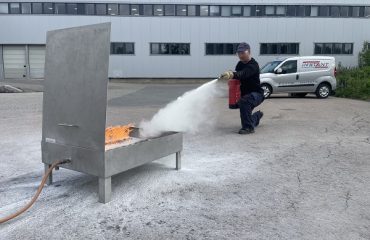
At the Norwegian Builders Association’s breakfast webinar, Special Advisor Stig Magnar Løvås from the Norwegian Labor Inspection Authority explained what is actually required in terms of safety training when using tools and work equipment.
Confusion in the industry
The requirements for documented safety training have created considerable uncertainty in the construction industry over the past year. Many find the regulations cumbersome and unclear, but the Labor Inspection Authority emphasizes that the purpose is safer use of work equipment—not bureaucracy for bureaucracy’s sake. “Training should be about the risks involved in use, not about cosmetic differences between brands and models,” Løvås emphasized during the webinar.
What does “documented safety training” mean?
Contractors have reacted to the fact that small differences between machine models are interpreted as requiring new training every time the equipment is changed. This creates major practical challenges, especially for small and medium-sized craft businesses.
Løvås explained that this interpretation is incorrect: “Some people have believed that training must be provided for each brand and serial number. That is not correct. Employers must provide training based on risk, not appearance,” he said.
The core of the regulations is that employers must assess the risks associated with the equipment and provide the necessary training if it could pose a hazard. The user manual is the most important tool in this assessment. “The user manual is the key to understanding the hazards and is therefore also the core of documented safety training,” explained Løvås.
What must be documented?
The documentation must show:
which equipment the training applies to,
who has received training, and
who has provided it.
New training is only required if the risk changes – not when changing brands or models with the same functionality. The training must be both theoretical and practical, and provide the employee with a basis for safe use, controls, and protective equipment, said Løvås.
When does training need to be renewed?
Documented training has no expiration date. However, it must be renewed if the risk changes, for example when new equipment is given different functionality or new safety mechanisms.
Løvås cited an example from the industry: “A battery-powered angle grinder started up unintentionally because the battery was connected. The transition from mains power to battery power entails a new risk profile, and employers must therefore assess the need for new training.
Such assessments should be documented. If the employer concludes that the risk does not increase, a brief explanation is sufficient. “If an accident at work occurs, the employer must be able to show what training and information has been provided,” emphasized Løvås.
The Labor Inspection Authority does not want excessive formality, but clear documentation that the company has done its part. Changed working conditions – such as working near flammable materials – may also trigger the need for new information or additional training.
Young workers and apprentices
Many people wonder how the requirements apply to apprentices, students, and young workers. Here, the message is clear: “Documentation from school may be valid, but the employer must verify that the knowledge has actually been understood,” said Løvås.
Younger workers need extra follow-up because they often lack experience and maturity. When assigning tasks, employers must assess which tasks are safe and provide training at a level they understand. Lack of maintenance is a frequent risk factor, and training must therefore also cover the checks that the user must perform themselves.
Watch the entire webinar from the Norwegian Builders Association on October 17 on YouTube.
Sources:
Byggmesteren.as
Norwegian Builders Association
Norwegian Labor Inspection Authority